Best Thermometer for Turkey: Instant-Read vs Leave-In Probe
As an Amazon Associate, CrispyCounter earns from qualifying purchases. Research-based guide built from manufacturer specifications and USDA Food Safety and Inspection Service guidance; not a hands-on test. Published Oct 30, 2026 (America/Chicago). No prices listed; check today’s price on Amazon.
USDA: 165°F in 3 spots3 instant-read picksManufacturer specs, not hands-on tests
We may earn a commission when you buy through links on this page. Learn more
Short answer: one fast instant-read thermometer does every safety check a turkey needs. Pick the Thermapen ONE if you cook meat every week, the Javelin PRO Duo for the best value, or the ThermoPro TP19H on a budget. Add a leave-in probe only if you want an alarm with the oven door shut. Whatever you use, the target is 165°F in three spots, per USDA.
The number that matters: 165°F in three spots
The USDA Food Safety and Inspection Service (FSIS) treats a whole turkey as safe once it reaches 165°F on a food thermometer in three places: the thickest part of the breast, the innermost part of the thigh, and the innermost part of the wing. If any one of those spots reads below 165°F, the bird keeps cooking. Stuffing cooked inside the bird must also hit 165°F in its center, which is one reason USDA suggests baking it separately in a dish.
The breast and the dark meat do not cook at the same rate. A turkey is a big, uneven shape, with thin wings, a deep breast and thighs tucked against the body. One reading is not enough; you are looking for the lowest of three readings. That is why the thermometer you choose matters more on Thanksgiving than on a weeknight chicken breast. You will take many readings with the oven open, often in bad light, and the tool has to make each one quick and easy.
Other USDA basics worth knowing: roast at an oven temperature no lower than 325°F, rest the bird about 20 minutes after it reaches 165°F, and keep cooked turkey at 140°F or above if you are not serving right away. A pop-up indicator does not replace a thermometer, because USDA still recommends checking all three spots.
Where to put the thermometer
Diagram: the three spots USDA FSIS says to check on a whole turkey. Stuffing, if any, gets checked in its center too.
Breast: go into the thickest part from the side or the neck end, holding the probe roughly parallel to the bone so the tip ends up in the deepest meat and not against the breastbone.
Thigh: aim for the innermost part, the thick meat between the drumstick and the body, without touching the thigh bone. Bone conducts heat differently and can give a misleading reading.
Wing: check the innermost part near the body. It is a small target, so a thin probe tip helps.
Find the cold spot: push the probe a little past where you think the center is, then draw it back slowly while you watch the display. The lowest number you see is the reading that counts. This only works well with a fast thermometer.
Instant-read vs leave-in probe
These two tools answer different questions. An instant-read answers “what is the temperature right here, right now?” You can move it between spots, so it is the tool that confirms all three USDA spots. A leave-in probe sits in one spot with a cable or wireless link to a base unit outside the oven. It answers “when should I come back?” by sounding an alarm at a temperature you set.
Instant-read (folding)
Leave-in probe (wired or wireless)
How you use it
Open the oven, check 3 spots, close
Set it once at the start; watch the base unit or app
What it tells you
Any spot you choose, including the coldest one
One spot, continuously, with an alarm
Oven door
Opened for every check
Stays shut until the alarm
Covers the USDA 3-spot check?
Yes, on its own
No; confirm with an instant-read at the end
Main weak spot
Slow models keep the door open longer
One spot only; cable or battery limits
Useful beyond turkey
Every steak, chicken, loaf of bread or pot of oil
Roasts, smokers, long cooks
How we read it: the instant-read is the one you need. A leave-in probe is an add-on that saves trips to the oven. USDA’s own roasting tips say that if you use an oven-safe thermometer, place it in the thickest part of the inner thigh. Once that spot reaches 165°F, check the wing and the thickest part of the breast. In other words, the leave-in probe tells you when to start checking, and the instant-read tells you when you are done.
Buying criteria for a turkey thermometer
Read speed. A turkey check is at least three readings, often repeated two or three times near the end, with the oven open and heat escaping. A thermometer that settles in about a second (Thermapen ONE’s spec) versus a few seconds (Javelin PRO Duo and TP19H specs) is the difference between a quick check and holding the door open while you wait. Speed also makes the “find the cold spot” technique practical.
Probe length. A large breast is deep. A probe around 4.3–4.5 inches, which all three of our picks have, reaches the center from the side while keeping your knuckles away from the hot bird.
Tip diameter. A thin, reduced tip puts the sensor in a small, precise spot and leaves a smaller hole. ThermoWorks lists the Thermapen ONE probe as narrowing to 0.06 inch, and Lavatools lists a 1.6 mm tapered tip on the Javelin PRO Duo.
Accuracy you can check. ±0.5°F and ±0.9°F specs are both tight compared with the gap between an undercooked thigh and a safe one. Getting the probe into the right spot matters more. What matters is that you can verify accuracy with an ice bath (32°F) before the holiday.
A display you can read at an angle. You will often be reading over a hot pan, maybe left-handed, maybe in a dim oven. Auto-rotating, backlit displays (all three picks) help more than you would expect.
Water resistance. You will rinse the probe between raw and cooked checks. IP67 (Thermapen ONE) is rated against temporary immersion. IP65 (Javelin PRO Duo, TP19H) is rated against water jets, so a rinse under the tap is fine but a dunk is not.
For a leave-in probe: the cable or probe has to be rated for your oven temperature. Look for a high-temperature alarm you can set, and if it is wireless, check the range from the oven to where you will actually be.
Spec comparison: our three instant-read picks
From the manufacturers’ published specifications (not our measurements). Check the current listing before you buy, because models get refreshed.
Spec
Thermapen ONE
Javelin PRO Duo
ThermoPro TP19H
Listed response
~1 second
Typically 2–3 seconds
A few seconds (3–4 s on the original spec sheet)
Listed accuracy
±0.5°F (−4 to 248°F)
±0.9°F (−4 to 302°F)
±0.9°F
Probe length
4.3 in
4.5 in
4.3 in
Sensor
Thermocouple
Thermistor, tip-mounted
Not stated on spec sheet
Water rating
IP67
IP65
IP65
Display
360° auto-rotate, auto backlight
2 in, auto-rotate, motion backlight
Auto-rotate, backlit, motion wake
Storage
Folding probe
Folding probe, magnet
Folding probe, magnet
Warranty (listed)
5 years
Limited 3 years
See current listing
Tradeoffs
Speed vs. spend. The Thermapen ONE’s one-second spec matters most when you check often. If you roast a turkey once a year and cook meat rarely, the extra speed is a luxury. If you cook meat weekly, you will use that speed every time.
Thermocouple vs. thermistor. Thermocouple sensors such as the Thermapen’s generally respond faster. Thermistor sensors, like the tip-mounted one Lavatools lists for the Javelin, are accurate but usually take a beat longer to settle. For a turkey, either works if you wait for the number to stop moving.
Leave-in convenience vs. single-spot blind spots. A probe in the thigh will not tell you about a cooler breast. It saves door openings, but it does not replace the final three-spot check.
Wired vs. wireless leave-in. Wired probes are simple and need no app. Wireless ones let you walk away but add charging and connection to the list of things that can fail on a holiday afternoon.
Busy kitchen, oven door constantly opened by others
Leave-in probe in the thigh, instant-read for the final check
Frying a turkey
Instant-read for the meat; use a thermometer rated for hot oil to watch the fryer, and follow the fryer maker’s safety directions
Turkey breast or parts only
One instant-read; check the thickest piece
Our recommendations
All three are the same tagged picks we cover on best meat thermometers, viewed here through a Thanksgiving lens. Check today’s price on Amazon, because they move around Black Friday.
Fastest checks#1
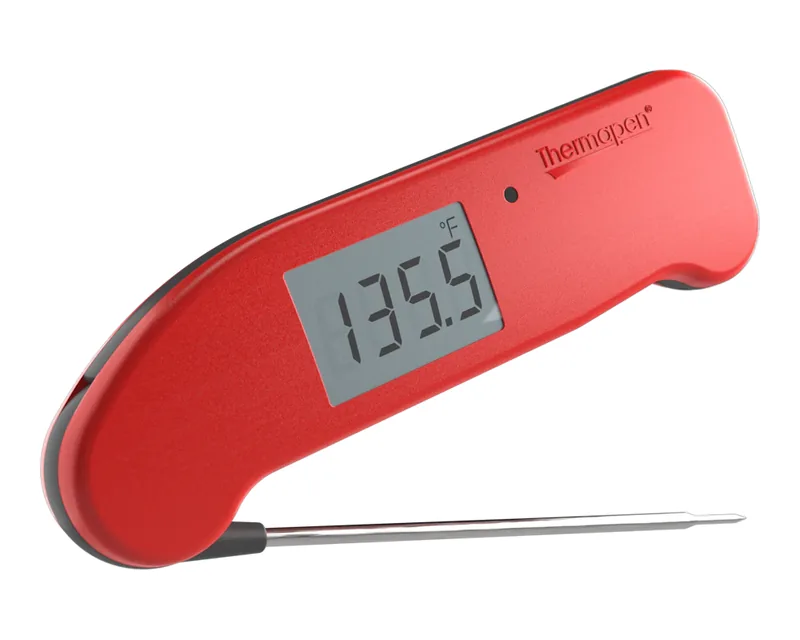
Premium — Thermapen ONE
Fastest turkey checks: ThermoWorks Thermapen ONE
ThermoWorks lists a one-second response, ±0.5°F accuracy from −4 to 248°F, a 4.3-inch probe that narrows to 0.06 inch, an IP67 rating and a 360° auto-rotating, auto-backlit display. For a turkey, that adds up to short door-open checks and an easy cold-spot sweep through the breast.
Best for: people who cook meat often and want the quickest three-spot check
Tradeoff: the most expensive of the three; check today’s price
Skip if: turkey is your only meat-thermometer job all year
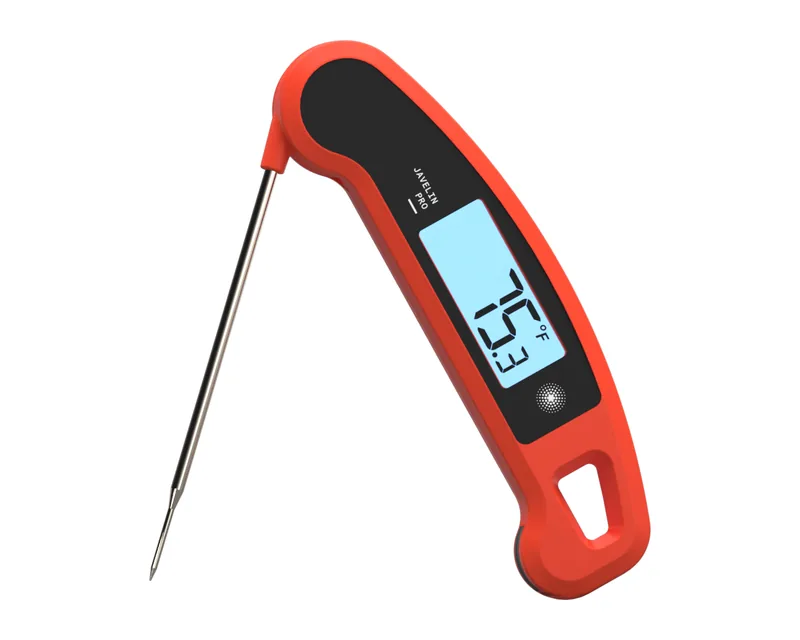
Best value for turkey day: Lavatools Javelin PRO Duo
Lavatools lists a typical 2–3 second response, ±0.9°F accuracy, a 4.5-inch probe with a 1.6 mm tapered tip, a 2-inch auto-rotating display with motion-activated backlight, a magnet and IP65 splash resistance. It is slower than the Thermapen but plenty fast for a careful three-spot check.
Best for: most households: the turkey once a year, chicken and steaks the rest of it
Tradeoff: a beat slower to settle; wait for the number to stop moving
Skip if: you want submersion-rated waterproofing (it is IP65, not IP67)
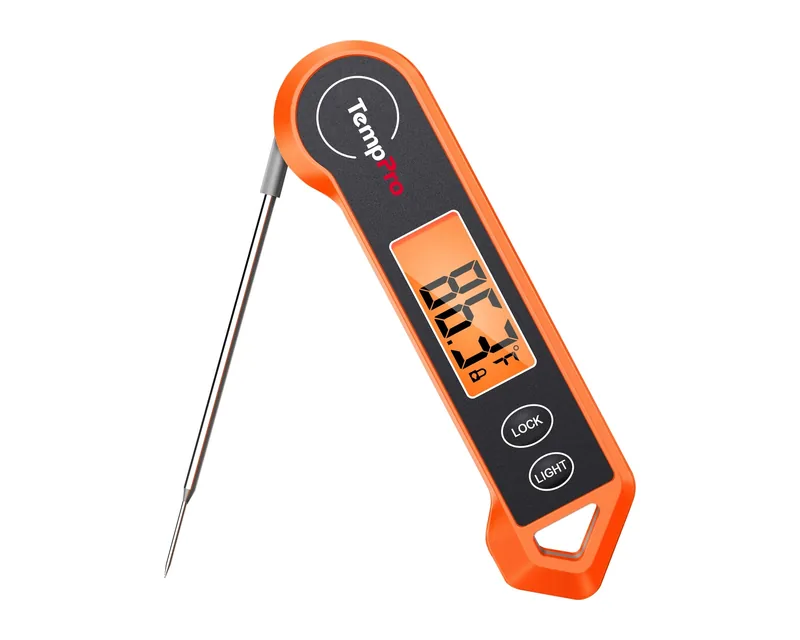
ThermoPro lists ±0.9°F accuracy, a 4.3-inch probe, an auto-rotating backlit display with motion wake, a magnet and IP65 water resistance. It does the USDA three-spot check for the least money of our picks.
Best for: a first thermometer, a backup, or a host who cooks meat a few times a year
Tradeoff: slower than the Thermapen; less premium build
Leave-in probes: we do not have a leave-in probe pick on CrispyCounter yet, so we are not linking one. If you add one, use the criteria above: oven-rated probe and cable, a settable alarm, and enough wireless range for your home.
Who this is for, and who it isn’t
Good fit: first-time turkey hosts, anyone who has served a dry breast while waiting on the thighs, people who rely on the pop-up timer, and cooks who want one tool they will use for the rest of the year.
Not for: people who already own a working, accurate instant-read. Run an ice-bath check and keep it. You also don’t need this if you are buying a fully cooked, reheat-only turkey, though you still want to reheat leftovers to 165°F. And don’t treat a leave-in probe as your only thermometer.
Turkey-day thermometer checklist
The day before: ice-bath check (32°F) and a fresh battery, or a spare in the drawer.
Start checking well before the recipe’s end time; birds vary.
Check all three spots and go by the lowest reading.
Wash the probe with hot, soapy water between a raw check and a cooked one.
165°F everywhere, then rest about 20 minutes before carving.
Stuffing in the bird? Check its center for 165°F too.
FAQ
Is the pop-up timer that came with my turkey enough?
No. USDA recommends checking with a food thermometer even when the bird has a pop-up indicator: 165°F in the thickest part of the breast and the innermost part of the thigh and wing. A pop-up only reports one spot.
What temperature is turkey safe at?
USDA FSIS lists 165°F as the safe minimum internal temperature for whole turkey and all poultry, measured with a food thermometer in the thickest part of the breast and the innermost thigh and wing. Stuffing must reach 165°F in its center too.
Can I take the turkey out early and let carryover finish it?
Large roasts keep climbing a few degrees while they rest, but USDA guidance is simple: every spot must reach 165°F. If you pull the bird before all three spots read 165°F, re-check after the rest and return it to the oven if any spot is short.
Do I need a leave-in probe if I already own an instant-read?
No. An instant-read thermometer can do every safety check on its own. A leave-in probe adds an alarm so you open the oven less, which helps most with big birds, smokers and busy kitchens. Always confirm the final reading with the instant-read in all three spots.
How do I know my thermometer is accurate?
Do an ice-bath check the day before: pack a glass with crushed ice, top it with cold water, stir, wait a minute and insert the probe in the center without touching the glass. It should read 32°F, within the accuracy the manufacturer lists.
How long should a turkey rest?
USDA suggests about 20 minutes after it reaches 165°F, so the juices set and carving is easier. If you are serving later, keep cooked turkey hot at 140°F or above.